Why Do Epoxy Floors Peel in Houston?
Most epoxy floors in Houston peel for one of two reasons. Water vapor is pushing up through the slab, or the concrete was never ground before the coating went on.
Both problems are found before the work starts. A moisture test reads the slab, and a diamond grinder gives the epoxy something to hold. The rest of the list is short. Humidity during the install, thin kit coatings, hot tires, and sun on a plain topcoat.
What do peeling, bubbling and yellowing tell you?
Each failure leaves a signature. The table matches what you see to the cause and to the step that prevents it.
| What you see | Usual cause | What prevents it |
|---|---|---|
| Sheets lifting off bare concrete | The slab was never ground, so nothing bonded | Diamond grinding to an open profile |
| Blisters or bubbles under the film | Water vapor rising through the slab | A moisture test, then a vapor barrier primer |
| White haze or soft, tacky spots | Coated too close to the dew point | Working when the slab is warmer than the dew point |
| Peeling in tire shaped patches | A thin, low solids film | 100 percent solids epoxy at full thickness |
| Amber color near the garage door | Sunlight on a plain epoxy topcoat | A UV stable topcoat over the epoxy base |
If you are asking why your epoxy garage floor is peeling, the first two rows cover most cases.
Why does slab moisture lift a coating here?
Most Houston homes and shops sit on slab-on-grade concrete poured over Gulf Coast clay. That clay holds water for months at a time. Concrete is porous, so vapor moves up through the slab and leaves at the top.
A cured epoxy film is far tighter than the concrete under it. Vapor that cannot pass collects at the bond line and pushes the coating off. The American Concrete Institute’s guide for slabs that receive moisture sensitive flooring lists blistering and delamination among the results.
A ready mix industry bulletin says the same about slabs on grade. Water vapor coming through the slab can make coatings fail, delaminate or discolor. Slab moisture is the top reason epoxy garage floors fail in this market.
How do you test a slab before coating it?
Two standard methods do the job. ASTM F1869 seals a dish of calcium chloride to the floor for about three days. The dish is weighed to see what the slab gave off. ASTM F2170 places probes in holes drilled into the slab and reads the humidity inside the concrete.
The two measure different things, so one does not replace the other. Every coating has its own pass level, and the reading decides the build. When a slab reads wet, a moisture vapor barrier primer goes down before the epoxy.
Our free on-site estimate includes that moisture check. One Google reviewer wrote that a vapor barrier was recommended before his coating went down. Three months in, he wrote, the floor still looked new.
Does Houston humidity change when a floor can be coated?
Yes, and the dew point is why. Coating standards call for the surface to stay at least 5 degrees F above the dew point. That holds through prep, application and cure. Houston mornings often sit close to that line.
When the slab is colder than the dew point, water condenses on it. The coating then goes over a damp surface, and epoxy can leave a whitish film called amine blush. The floor looks cloudy and the bond is weak.
So the work gets planned around the slab and the weather. Polyaspartic floor coatings help here, because polyaspartic cures well in high humidity and returns a floor to service fast.
Why does grinding decide the outcome?
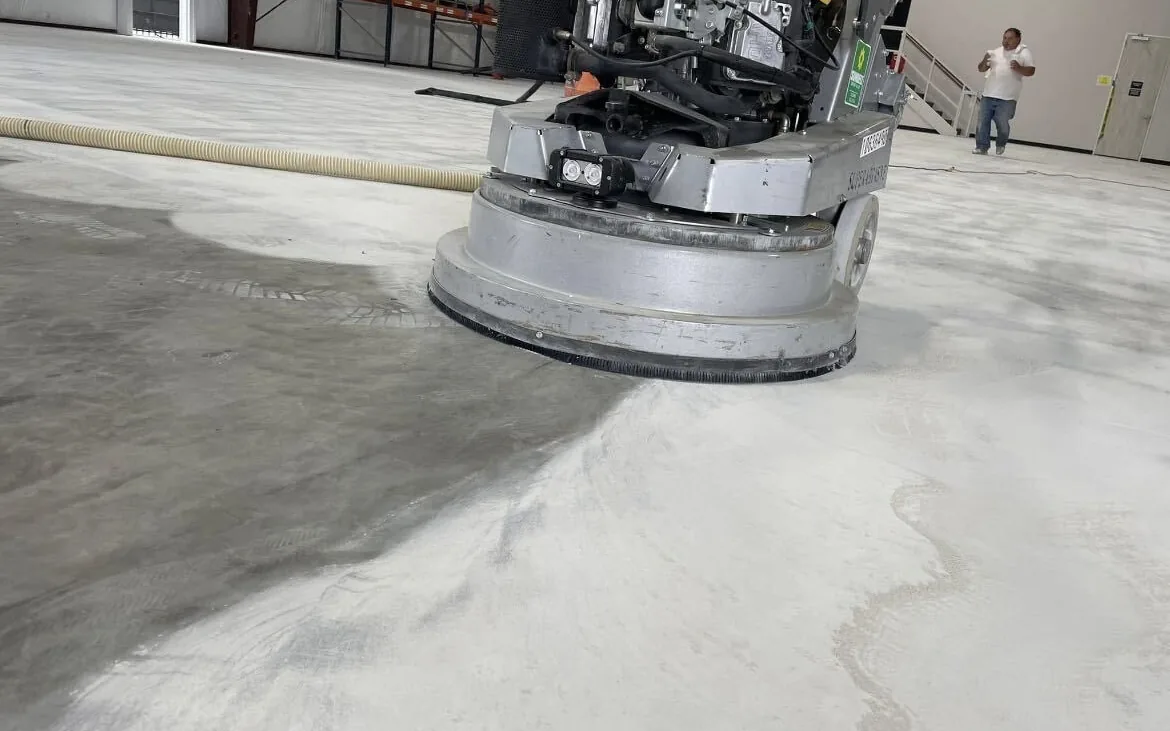
Concrete leaves a weak, dusty layer at the surface called laitance. A coating bonded to laitance peels off with it. Diamond grinding takes that layer away and opens the pores so the epoxy can key in.
The concrete repair industry’s surface preparation guideline grades the result on a scale of ten concrete surface profiles. High build coatings sit in the middle of that scale. The same guideline warns that poor preparation leads to failure of the protective system.
Prep is also where a shortcut hides. Once the color goes on, nobody can see what was under it.
Why do thin kits and hot tires peel a garage floor?
Hot tire pickup is the classic garage failure. Tires come home hot and soft, they grab the film, and they lift it as they cool. Houston pavement stays hot for months, so this runs all summer.
Store kits are usually water based and go down a few mils thick, close to a coat of paint. A film that thin cannot hold against a hot tire. It also wears through where you walk and where the car turns.
100 percent solids epoxy has no water or solvent to flash off. It cures at nearly the thickness it was applied at. That is why it is our base coat under a clear topcoat.
Why did my epoxy floor turn yellow?
Standard epoxy resin is aromatic. Coating chemistry sources explain that aromatic resins chalk and amber under ultraviolet light. The strip inside a sunny garage door usually goes first, because that is where the light lands.
The topcoat is the answer. Polyaspartic and polyurethane topcoats are aliphatic, and aliphatic coatings hold their color in sunlight. Our recommended build is an epoxy base for bond, with a UV stable topcoat over it. Before you pick one, read how the three chemistries compare.
What do you do about a floor that is already peeling?
Grind it off. A new coating over a failed one inherits the failed bond, so the loose material comes off first. Then the slab gets tested, ground back to clean concrete and recoated.
Coating troubleshooting guidance points the same way. Adhesion and moisture testing find the cause before anyone opens a bucket. A floor that peeled from slab moisture will do it again without a vapor barrier primer under the new system.
A floor that is worn but still bonded is a different case, and machine scuffing plus a recoat can work. We handle the prep and the coating, and that includes grinding an old coating off the slab. In a shop or warehouse the order is the same, and commercial epoxy flooring follows the same test first rule.
What does a floor that lasts in Houston take?
Four things, in this order. Test the slab, then grind it to a real profile. Install 100 percent solids epoxy at full thickness, then finish with a UV stable topcoat. Skip one step and the floor shows it within a year or two.
That is the build behind a garage floor coating done right. The order is the same on a warehouse slab. Estimates are free and often come back within a day. Call or text (281) 831-5656 and we will read your slab first.