Polished Concrete vs Epoxy: Which Floor Fits Your Houston Space?
Polished concrete is the slab itself, ground and polished with diamond tooling to a sheen. Epoxy is a coating that builds a new surface on top. For a home garage, epoxy wins: it stands up to oil and hot tires, and flake hides cracks and patches. For an aircraft hangar, a light coated floor reflects overhead light and resists jet fuel and hydraulic fluid.
In warehouses, retail stores and showrooms, either floor can work. The choice turns on the slab’s condition and the chemicals it will see. It also turns on the look you want and whether the floor must hide patches and stains. At home, it comes down to looks: polished concrete’s sheen or a metallic or solid color epoxy floor.
Epoxy One installs floor coatings: epoxy, polyaspartic and polyurea. We do not polish concrete. So this guide shows where each floor fits and where a coating is the better buy. Every cost figure below is a national market number, not our price list.
What is the difference between polished concrete and epoxy?
To polish concrete, the slab is ground with metal-bond diamond tooling. Finer and finer diamond pads then polish it. A densifier is applied along the way to harden the surface. A national cost guide says the number of grinding passes sets the final sheen.
There is no thick coating on top. Another national cost guide says true polished concrete doesn’t need sealing, since densifying hardens the surface. The same guide says a stain guard sealer helps prevent staining in kitchens and garages.
An epoxy floor works from the top. The slab is diamond ground, cracks and joints are repaired, and the slab gets a moisture test. Then an epoxy base coat goes down, since epoxy bonds to concrete best.
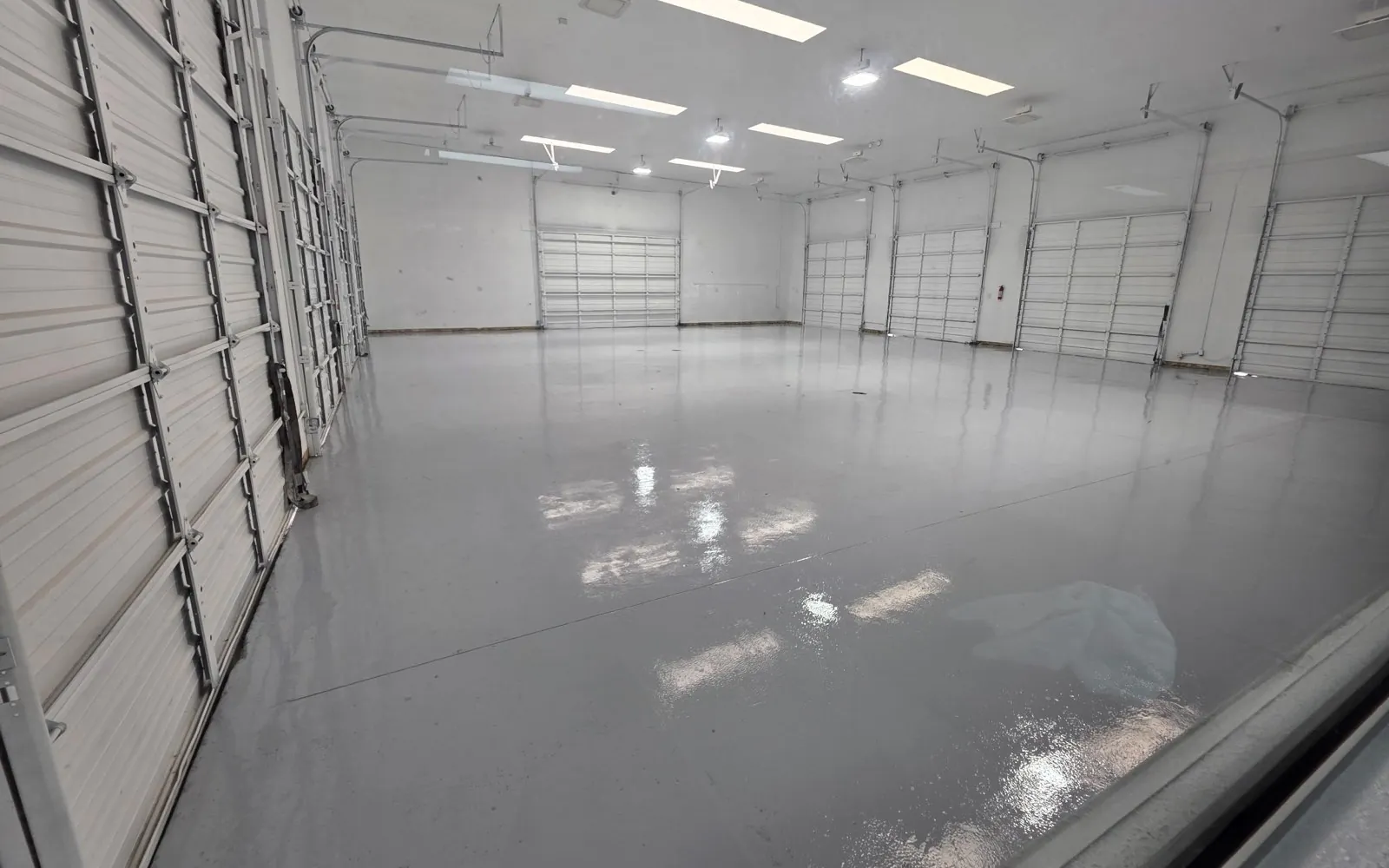
A clear polyaspartic, polyurea or polyurethane topcoat goes over it. On warehouse and showroom slabs, our commercial epoxy flooring is typically 2 to 3 millimeters thick.
How do polished concrete and epoxy compare side by side?
Both floors begin with the same slab and with diamond grinding.
| Polished concrete | Epoxy coating | |
|---|---|---|
| How it works | The slab is ground and densified to a sheen | A coating bonds to the ground slab as a new surface |
| Look | The concrete itself; the polish level sets the shine | Solid color, flake, quartz or metallic |
| Patches and cracks | Extensive patchwork still shows through | Cracks get repaired, and flake hides flaws |
| Oil and chemicals | Not completely stain proof; acid spills can damage it | Epoxy resists chemicals |
| Wet floors | Slippery when wet if it does not meet OSHA and ADA standards | Gloss gets slippery; flake, quartz or aluminum oxide add grip |
| Upkeep | No waxing; sealing is optional | Easy to clean, but polished tends to need less upkeep |
| Good fit | Sound slabs where you like bare concrete | Garages, hangars and slabs with flaws to cover |
A national cost guide says epoxy is durable and highly customizable, while polished concrete tends to need less maintenance.
Which floor fits which space?
Warehouses, retail and showrooms: either can work. Most structurally sound slabs can be polished, and a concrete trade site calls polished floors extremely durable. But spalled areas and extensive patchwork still show through after polishing.
Chemical or acid spills can also damage polished concrete, while epoxy resists chemicals. A coating covers flaws and can carry safety striping and custom logos set into the floor.
Aircraft hangars: a light, coated floor. Coating makers’ hangar guides call for floors that reflect overhead light, so crews can see spills and dropped tools. A hangar flooring system guide says properly engineered systems resist jet fuel, oils, hydraulic fluids and cleaning agents. Our hangar floor coatings page covers the full system.
We coated the hangar floors at the Lone Star Flight Museum, where the two hangars total 60,000 air-conditioned square feet. A customer wrote that the museum moves 40 or more planes a month across them.
Home garages: epoxy. In the polished concrete vs epoxy garage floor matchup, a coating is the better buy. Our epoxy garage floors are built for hot tire pickup resistance and easy cleaning. Flake epoxy floors also hide the cracks and patches a polish would show.
Home interiors: it comes down to the look. Polished concrete shows the slab itself, and the polish level sets how reflective it looks. Grinding deeper reveals different layers in the concrete, which changes the style.
Metallic epoxy floors work pigments into marble or veined patterns, and every floor is one of a kind. Solid color epoxy floors come in gloss, satin or flat. Both are on our interior epoxy floors page.
What do polished concrete and epoxy cost?
A national cost guide says most polished concrete floors cost $2 to $16 per square foot. Another national guide puts a professionally installed epoxy garage floor at $3 to $12 per square foot. These are market numbers, not our price list.
| Floor | National market band | Source |
|---|---|---|
| Polished concrete | $2 to $16 per sq ft | A national cost guide |
| Epoxy garage floor, professionally installed | $3 to $12 per sq ft | A national guide |
The two bands overlap, so neither floor is cheaper across the board. On polished concrete, the finish type is one of the most direct cost drivers. On both, the slab’s condition drives the prep, and repairs add cost. For the local picture, see epoxy garage floor cost in Houston and commercial epoxy flooring cost.
How does Houston moisture change the choice?
Summer mornings in Houston average over 90 percent relative humidity. Our polyaspartic floor coatings cure in high humidity. A coating also faces moisture from below.
Water vapor can move up through a slab, and a concrete industry bulletin ties it to failed coatings. A national guide says too much vapor makes a coating delaminate from underneath. So every job we install includes a moisture test, with a vapor barrier primer where the test calls for it.
Polished concrete has no thick coating for that vapor to lift, since true polished concrete needs no sealer. Our post on why epoxy floors peel explains the moisture tests.
Slip resistance is the other wet-weather question. A national cost guide lists polished concrete as slippery when wet if it does not meet OSHA and ADA standards. Glossy epoxy can get slippery when wet too. Coatings get flake, quartz or aluminum oxide for grip, and wet work areas can get anti slip floor coatings.
Which one should you pick?
Pick polished concrete for a sound slab where you like the look of bare concrete and want less upkeep. Pick a coating when the floor sees oil and chemical spills, or when patches and cracks need to disappear. Our stained concrete vs epoxy guide covers another slab finish.
We are based in the Memorial area of Houston and have installed floor coatings across Greater Houston since 2008. Estimates are free, and quotes often come back within a day. See the coated side on our commercial epoxy flooring page, or call or text (281) 831-5656.